Repetition needs a useful question
In a hockey session, repetition can help a player become familiar with a movement or decision. But repeating an action without attention can turn practice into a count rather than a learning experience. Coaches can give a drill a clear purpose: scan before receiving, keep the puck protected through a turn, or choose a route based on a defender’s position. The instruction should be specific enough to guide attention without trying to control every small movement.
Facilities influence what kinds of practice are possible. A full sheet offers room for speed, spacing and longer transitions. A smaller practice area can support close control and quick exchanges. A synthetic surface, shooting lane or dryland stick-handling corner can let a group work on selected actions without competing for ice time. These settings differ from skating, so staff should be clear about which element they are practising and what does not transfer automatically.
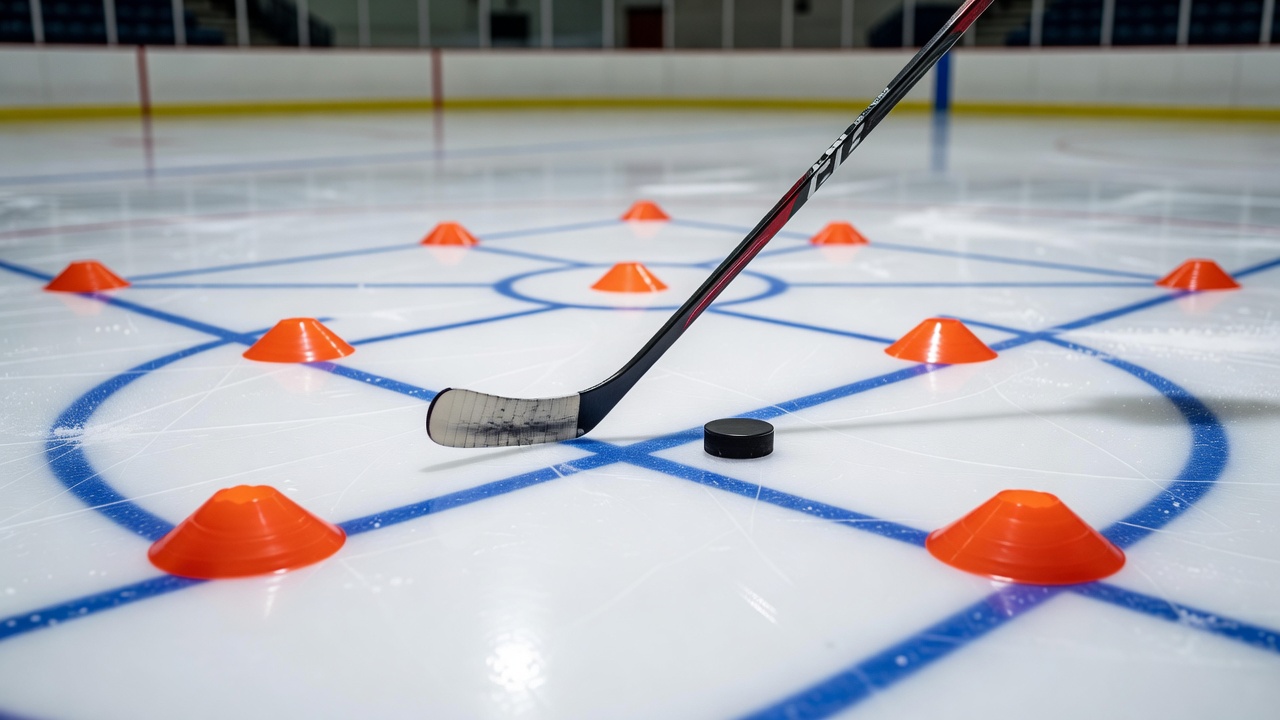
Space allocation matters. A poorly marked drill can bring players into one another’s paths or leave a group waiting without a role. Cones, boards, clear entry points and station signs can make the task easier to understand. However, equipment should not create hazards or obscure sight lines. Coaches need enough room to supervise, demonstrate and change the activity as the group responds.
Design progressions, not just stations
A progression begins with an understandable challenge and changes one or more demands over time. A player might first perform a movement without pressure, then add a puck, then make a choice in response to a teammate or defender. The sequence should suit the learner, not follow a fixed ladder for its own sake. Coaches can simplify a task when it becomes confusing or increase its challenge when the group is ready.
The environment can adjust the task without elaborate technology. A coach can narrow the space, change a starting angle, add a target or alter the number of available options. Players then have to perceive and respond, rather than merely follow a memorized path. The facility’s markings and equipment storage help staff make these changes quickly. A well-organized room or rink allows more of the session to be spent on the coaching objective rather than retrieving misplaced items.
Age, experience and context shape the right level of challenge. Younger participants may need more time to understand the route and rules. Experienced players may benefit from a task that changes with a defender’s position or a teammate’s movement. Neither case is a reason to prescribe one drill for everyone. Coaches should watch how players respond and adjust the environment or instruction accordingly.
Make feedback clear and proportionate
Feedback can come from a coach, a teammate, the player’s own sensation or a recorded observation. It should help the learner notice something relevant. A concise cue can be more useful than a stream of corrections. Staff might ask what the player saw, where the puck went or which option seemed available. Such questions make the athlete an active participant in interpreting the attempt.
Video and tracking tools can provide additional information, but they are not necessary for every session. A phone recording can help clarify a movement if it is used respectfully, stored appropriately and reviewed for a specific reason. Coaches should avoid turning every practice into constant measurement. A tool is worthwhile when it helps answer a real question and when the people involved understand the limits of what it shows.
Feedback also depends on timing. A group may benefit from a short pause after a sequence, while a player may need a quick cue before the next repetition. If the space is noisy or the activity is moving rapidly, a coach might gather the group at a designated spot to explain a change. Clear sight lines and a place to listen can make those moments easier without interrupting the session unnecessarily.
Connect ice skills with off-ice work
Development areas can provide another angle on a skill. Players might rehearse puck control on a training surface, practice a shooting movement in a lane or work on physical qualities away from the ice. The goal is not to claim that every off-ice exercise reproduces hockey. Instead, coaches can identify a specific component to practise and then decide how to revisit it on the sheet.
A simple bridge is a shared coaching cue. If a player has been asked to scan before receiving a pass, staff can reinforce that idea in a suitable off-ice task and then observe it in a game-like ice drill. The activity should remain appropriate to the setting and the player. A puck on a dry surface will move differently, and movement without skates does not carry the same balance demands as skating. Naming those differences helps athletes understand why the task changes.
Transitions also contribute to learning. A player who has time to remove gear, hear the next objective and enter the new activity calmly is better positioned to understand the task than one rushed through a crowded route. The facility can support this with a schedule, a designated meeting point and convenient equipment storage. Coaches supply the explanation; the environment gives that explanation a place to happen.
Notice more than the drill itself
Parents and players observing practice can look for purpose, not just speed. Are athletes given a clear starting point? Does a task change when the group struggles or succeeds? Do coaches use language players can understand? Are rest and instruction organized so participants know when to move? These signs offer a more grounded impression of a session than a high count of drills or a dramatic display.
Development is gradual and individual. A single practice cannot show a player’s full progress, and a well-equipped venue cannot promise a particular outcome. Health, experience, coaching, attendance, motivation and many other factors shape what happens. A careful facility guide should describe the setting and routines without making claims about guaranteed performance.
Good practice environments treat mistakes as information. A missed pass, an unstable turn or a poor decision can prompt a useful question. The coaching task is to help an athlete interpret the attempt and try again with an appropriate adjustment. In that sense, the best training space is one that makes it safe and practical to focus, repeat, pause and reflect.